
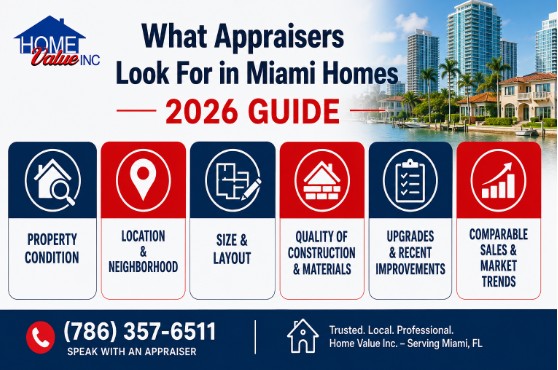
Miami real estate appraisers evaluate gross living area (GLA), permitted improvements, comparable sales, and location-specific risk such as FEMA flood zone classification when determining a property’s value.
Jhovan F. Rojas, Florida Certified Residential Appraiser (License RD6109, licensed since 2006), applies ANSI Z765-2021 measurement standards to every general value appraisal assignment.
Homeowners who understand these evaluation criteria in advance can address correctable issues — such as an unpermitted addition, an outdated roof, or a missing elevation certificate — before the inspection date.
Unpermitted work and inflated square footage claims can derail a Miami appraisal — get ahead of it with Jhovan Rojas at Home Value Inc. Request a quote.
A real estate appraiser is a state-licensed professional who determines a property’s fair market value through an on-site inspection, verified comparable sales analysis, and a written report accepted by lenders, courts, and government agencies.
In Miami, appraisers weigh gross living area, property condition, location-specific risk such as flood zone classification, and verified permitted improvements on every assignment — each documented separately in the final report.
Rojas notes that the most common value-limiting issue on Miami assignments isn’t condition — it’s an addition or enclosed space with no matching permit on file, which the appraiser must exclude from GLA regardless of finish quality.
Florida State Certified appraisers must meet the licensing standards set by the Florida Department of Business and Professional Regulation, the state authority governing appraiser credentials and conduct statewide.
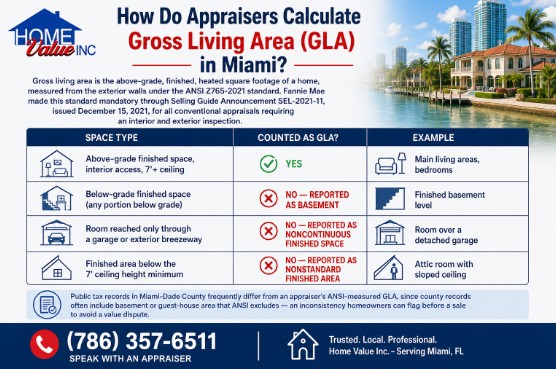
How Do Appraisers Calculate Gross Living Area (GLA) in Miami?
Gross living area is the above-grade, finished, heated square footage of a home, measured from the exterior walls, in accordance with ANSI Z765-2021.
Fannie Mae made this standard mandatory through Selling Guide Announcement SEL-2021-11, issued on December 15, 2021, for all conventional appraisals that require an interior and exterior inspection, with compliance required for appraisals dated on or after April 1, 2022.
If you’re ready to get started, call us now!
| Space Type | Counted as GLA? | Example |
|---|---|---|
| Above-grade finished space, interior access, 7’+ ceiling | Yes | Main living areas, bedrooms |
| Below-grade finished space (any portion below grade) | No — reported as basement | Finished basement level |
| Room reached only through a garage or exterior breezeway | No — reported as noncontinuous finished space | Room over a detached garage |
| Finished area below the 7’ ceiling height minimum | No — reported as nonstandard finished area | Attic room with sloped ceiling |
Public tax records in Miami-Dade County frequently differ from an appraiser’s ANSI-measured GLA, since county records often include basement or guest-house area that ANSI excludes — an inconsistency homeowners can flag before a sale to avoid a value dispute.
Rojas cross-references the county’s recorded square footage against his own ANSI measurement on every assignment specifically to catch this gap before it becomes a dispute during underwriting.
Miami’s coastal geography makes FEMA flood zone classification a location factor appraisers document on nearly every assignment, since Special Flood Hazard Area (SFHA) designation affects lender insurance requirements and buyer demand.
Zone AE marks high-risk inland flooding areas, while Zone VE marks high-risk coastal flooding with wave action — a distinction confirmed on the Miami-Dade County flood zone map, the authoritative FEMA-derived source for a specific address, that affects both insurance cost and appraiser risk commentary.
Confirming this designation before listing helps a homeowner anticipate insurance costs that could affect a buyer’s financing.
Home Value Inc.’s dedicated breakdown of Miami’s property appraisal system covers how waterfront exposure and flood zone designation factor into the valuation.
For the broader submarket context behind Miami location pricing, the real estate appraiser’s overview breaks down how neighborhood boundaries affect the selection of comparables.
An appraiser identifies three to five recent sales most similar to the subject property in location, size, condition, and property type, then applies line-item adjustments for measurable differences between each comparable and the subject.
| Adjustment Category | What the Appraiser Compares |
|---|---|
| Gross living area | Above-grade square footage difference between subject and comparable |
| Waterfront or view exposure | Direct water access, view quality, and elevation |
| Condition and updates | Age and quality of kitchen, bath, and mechanical systems |
| Permitted additions | Verified square footage added through Miami-Dade building permits |
| Flood zone classification | SFHA designation and elevation certificate status |
The comparable sales timeline covers how far back an appraiser can pull qualifying sales in a given Miami submarket, so sellers can anticipate which recent transactions the appraiser is likely to weigh most heavily.
Homeowners disputing an assessed value can apply the same comparable analysis to a tax-protest appraisal filed with the county.
Appraisers verify that any structural addition, kitchen remodel, or square footage increase carries a matching permit on file with the municipality, since appraisers typically exclude unpermitted work from the appraised value or flag it as a condition item.
A common Miami-specific pattern Rojas encounters: a converted garage or enclosed patio that looks finished and livable but lacks a permit — that space is excluded from GLA even when it’s fully drywalled and air-conditioned.
The Miami-Dade County Property Appraiser’s public records database shows permit history alongside assessed value, giving homeowners a way to confirm which improvements are already on file before the inspection.
Home Value Inc.’s pre-appraisal checklist outlines the specific permit and improvement documents an appraiser most often requests.
If you’re ready to get started, call us now!
USPAP requires an appraiser to physically inspect the interior and exterior of the subject property for assignments involving a full inspection, documenting condition, functional layout, and any deferred maintenance that affects value.
Interior walkthrough items include the condition of the kitchen and bathroom, flooring, HVAC age, and evidence of water intrusion. Exterior items include roof condition, structural integrity, and any visible code violations that could affect marketability.
Home Value Inc.’s pre-appraisal checklist covers which rooms and systems typically draw the closest inspection during the walkthrough.
Preparation directly affects appraisal accuracy, so gathering the right documents before the inspection date gives the appraiser what’s needed to support every adjustment in the final report.
Homeowners benefit from compiling permit records, recent renovation receipts, and — for waterfront or low-elevation properties — a current elevation certificate, since each document can support a condition or location adjustment the appraiser would otherwise estimate.
The pre-appraisal checklist organizes every recommended document by property type before the appraiser arrives.
Miami’s flood zones, permit records, and comparable sales each shift what a property is really worth — request a certified valuation from Home Value Inc. today. Order an appraisal.
What do appraisers look for when valuing a home in Miami?
Miami appraisers evaluate gross living area, property condition, permitted improvements, and location-specific risk, including FEMA flood zone classification. Each factor is documented separately in the appraisal report and supports the adjustments applied to comparable sales during the valuation process.
How do appraisers measure gross living area?
Appraisers measure gross living area from the exterior walls of the home using the ANSI Z765-2021 standard, counting only above-grade, finished, heated space with interior access and at least seven-foot ceilings. Fannie Mae has required this standard since April 2022.
Does an unpermitted addition affect a Miami appraisal?
Yes. Appraisers typically exclude unpermitted square footage from the reported gross living area or flag it as a condition item in the report. Home Value Inc. cross-references Miami-Dade County permit records against the subject property using the county’s public permit database.
Does a home’s FEMA flood zone affect its appraised value?
Yes. FEMA flood zone classification affects lender-required insurance costs and buyer demand, both of which factor into an appraiser’s location adjustment. Zone VE coastal properties carry different risk commentary than Zone AE inland properties per the county’s flood zone map.
How many comparable sales does a Miami appraiser use?
A Miami appraiser typically analyses three to five recent comparable sales most similar to the subject property in location, size, condition, and property type. Each comparable receives explicit adjustments for measurable differences, supported by written analysis, before being reconciled to a final value.
What condition issues do appraisers flag during inspection?
Appraisers flag deferred maintenance items, including the condition of the roof, evidence of water intrusion, outdated mechanical systems, and visible code violations. Each flagged item can result in a downward adjustment to the condition relative to comparable sales without the same deferred maintenance items noted during inspection.
Can a homeowner be present during the appraisal walkthrough?
Yes. Homeowners can be present during the inspection to answer questions about permitted improvements, renovation dates, and property history. The appraiser conducts the physical inspection and analysis independently throughout the appraisal process, regardless of who is present.
What is a USPAP-compliant appraisal?
A USPAP-compliant appraisal follows the Uniform Standards of Professional Appraisal Practice, the federally recognized performance standards governing all licensed appraisers nationwide. Miami lending, divorce, estate, and tax appeal assignments each require USPAP compliance, which must be documented in every certified report delivered to a lender or court.
How can a Miami homeowner prepare for an upcoming appraisal?
Homeowners can prepare by gathering permit records, renovation receipts, and any elevation certificates before the inspection date, particularly for waterfront or flood-zone properties. Organized documentation enables the appraiser to support condition and location adjustments with verified paperwork rather than an on-site estimate.
About the Author
South Florida Residential Appraiser · Expert Witness · Residential Valuation Specialist
Jhovan Rojas is a South Florida residential real estate appraiser with more than 20 years of experience valuing residential properties throughout Miami-Dade, Broward, and Palm Beach Counties. His appraisal experience spans multiple real estate market cycles, including the foreclosure-driven downturn of the late 2000s, the subsequent recovery period, and the rapid appreciation that followed the COVID-19 housing boom.
Throughout his career, Jhovan has appraised thousands of residential properties, including single-family homes, condominiums, multi-family residences, luxury estates, waterfront properties with boating access, and complex high-value residential assets. His expertise includes residential valuation, appraisal review, market analysis, lender compliance review, and expert witness services for litigation involving real estate valuation disputes.
In addition to performing residential appraisals, Jhovan has conducted appraisal reviews for lending institutions, supervised and mentored trainee appraisers, and provided expert testimony in divorce and property-related legal matters. He is also a frequent speaker for Realtor and broker education programs, where he shares insights on valuation methodology, appraisal standards, market trends, and factors influencing residential property values throughout South Florida.
Drawing on decades of hands-on appraisal experience, Jhovan helps homeowners, attorneys, lenders, real estate professionals, and property investors make informed decisions based on credible, well-supported valuation analysis.
Home Value Inc. performs residential and commercial appraisals for its clients in greater Miami-Dade County and the following cities in South Florida. We provide services to the following cities -