
Finding a home appraiser in Miami-Dade County starts with knowing which of two separate offices to contact.
The Miami-Dade County Property Appraiser sets assessed value for property tax purposes only, while a private fee appraiser provides the independent valuation lenders, courts, and insurers typically rely on for lending, divorce, estate, or PMI-removal decisions.
Acceptance standards vary by the lender, court, or insurer involved, but none treat the county’s assessed value as a substitute for an independent appraisal.
Homeowners who need an independent, USPAP-compliant appraisal for a lender, court, or insurer can request a free consultation with Home Value Inc. today.
The Miami-Dade County Property Appraiser is a locally elected government office responsible for determining the assessed value of every parcel in the county for ad valorem tax purposes.
Tomas Regalado currently holds the elected position, and his office, the Property Appraiser of Miami-Dade County, mails a Notice of Proposed Property Taxes (TRIM Notice) to every property owner each August.
Florida law assigns this office a narrow, statutory duty. Under Florida Statutes § 193.023, the property appraiser must complete an assessment of every parcel’s value no later than July 1 each year and physically inspect each property at least once every five years.
That assessed value supports property tax administration, so property owners who need a valuation for a sale, mortgage, divorce, or estate matter should use a private appraiser instead.
A private fee appraiser is a Florida-certified or -licensed professional retained directly by a homeowner, attorney, lender, or court to determine a property’s fair market value for a specific transaction or legal proceeding.
Under Florida Statutes § 475.612, Chapter 475, Part II, only a person certified, licensed, or registered by the Florida Department of Business and Professional Regulation may issue an appraisal report or use a corresponding professional title.
Florida currently recognizes two active certification tiers—certified residential and certified general appraiser—both administered through the same DBPR licensing system, which is why the state’s verification tool is called a “license” lookup even for certified professionals.
Home Value Inc., a Florida-certified residential appraisal firm based in Miami Springs, Florida, employs three Florida Certified Residential Appraisers: Rojas, Emily Rojas, and Renato Salgado.
The firm does not subcontract assignments to outside appraisers, and every report carries full Errors & Omissions insurance coverage.
If you’re ready to get started, call us now!
Miami-Dade homeowners should contact the county property appraiser’s office directly for a specific, narrow set of tasks tied to property tax administration:
Homeowners preparing a formal property tax appeal to Miami-Dade’s Value Adjustment Board can strengthen their petition with independent valuation evidence — an appraisal report is one of several accepted evidence types alongside comparable sales, repair documentation, and photographs.
Situations involving a lender, a court, an insurer, or a legal deadline generally call for a private fee appraiser, though the exact documentation requirements depend on the specific recipient and transaction. Common triggers include:
For mortgage transactions specifically, the federal banking agencies’ Interagency Appraisal and Evaluation Guidelines require the lender or its agent to select and engage the appraiser directly —a borrower-ordered appraisal cannot be used for the loan itself.
Separately, Regulation Z’s valuation-independence rule (12 CFR § 1026.42) prohibits any party from pressuring the appraiser’s independent judgment once selected.
A homeowner can still order a private appraisal directly for non-lending purposes, such as a divorce, estate, or pre-listing decision.
Homeowners requesting a PMI removal appraisal need the same USPAP-compliant methodology as the situations above.
Miami-Dade homeowners facing a divorce settlement, estate deadline, or PMI removal request can schedule an appraisal with Home Value Inc. this week.
If you’re ready to get started, call us now!
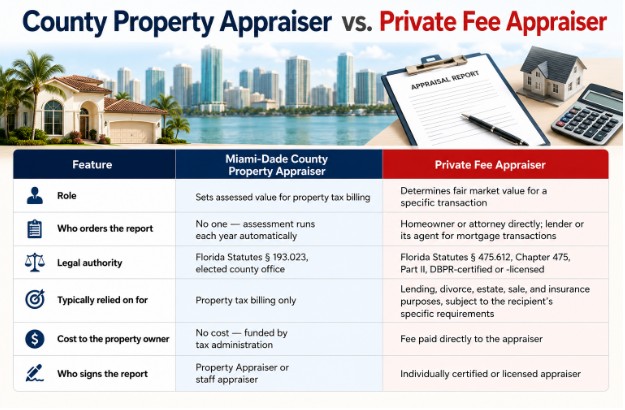
| Feature | Miami-Dade County Property Appraiser | Private Fee Appraiser |
| Role | Sets assessed value for property tax billing | Determines fair market value for a specific transaction |
| Who orders the report | No one — assessment runs each year automatically | Homeowner or attorney directly; lender or its agent for mortgage transactions |
| Legal authority | Florida Statutes § 193.023, elected county office | Florida Statutes § 475.612, Chapter 475, Part II, DBPR-certified or -licensed |
| Typically relied on for | Property tax billing only | Lending, divorce, estate, sale, and insurance purposes, subject to the recipient’s specific requirements |
| Cost to the property owner | No cost — funded by tax administration | Fee paid directly to the appraiser |
| Who signs the report | Property Appraiser or staff appraiser | Individually certified or licensed appraiser |
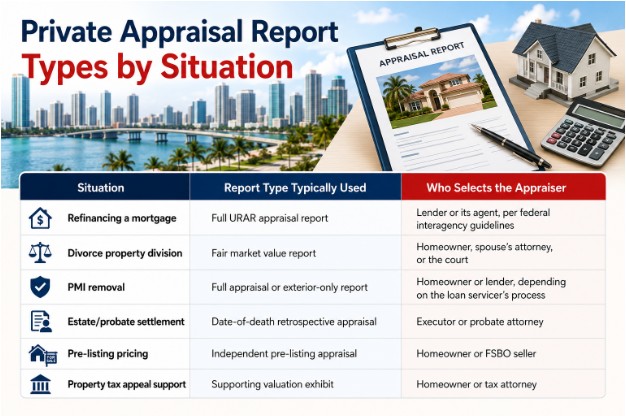
| Situation | Report Type Typically Used | Who Selects the Appraiser |
| Refinancing a mortgage | Full URAR appraisal report | Lender or its agent, per federal interagency guidelines |
| Divorce property division | Fair market value report | Homeowner, spouse’s attorney, or the court |
| PMI removal | Full appraisal or exterior-only report | Homeowner or lender, depending on the loan servicer’s process |
| Estate/probate settlement | Date-of-death retrospective appraisal | Executor or probate attorney |
| Pre-listing pricing | Independent pre-listing appraisal | Homeowner or FSBO seller |
| Property tax appeal support | Supporting valuation exhibit | Homeowner or tax attorney |
Appraisers who handle Miami-Dade litigation, lending, and estate assignments routinely see the same intake gap: a homeowner names the situation — divorce, probate, refinance — but not the report’s intended use or intended user, and that gap can change scope, methodology, and turnaround before work even begins.
Homeowners get a more accurate quote and a faster assignment by confirming the following before hiring:
Homeowners hiring a private fee appraiser in Miami-Dade County should confirm three credentials before signing an engagement letter: active Florida certification or licensure, USPAP compliance, and Errors & Omissions insurance coverage.
Every certified or licensed Florida appraiser carries a registration number issued by the Department of Business and Professional Regulation.
Homeowners can confirm status, expiration date, and any disciplinary history through the DBPR license lookup.
A real estate appraiser who cannot produce an active DBPR number in Miami-Dade County should not be hired for any assignment requiring a certified appraiser’s report.
The Uniform Standards of Professional Appraisal Practice (USPAP) is a set of ethics and reporting standards published by The Appraisal Foundation.
Under Florida Administrative Code Rule 61J1-4.003, every registered, licensed, or certified Florida appraiser must complete 30 hours of continuing education during each renewal period, including a 7-hour National USPAP Update Course.
An appraiser who cannot confirm current USPAP training may not meet the baseline standard lenders, courts, and insurers generally expect, which homeowners should treat as a hiring red flag.
Private appraisal cost in Miami-Dade County varies by property type, report complexity, and turnaround timeline rather than a single flat rate.
Homeowners comparing quotes should ask for a written scope of work before hiring, since a standard residential report and a litigation-grade narrative report require different levels of documentation.
Homeowners refinancing a property can review Home Value Inc.’s mortgage lending appraisal service for lender-specific requirements.
The Miami appraisal cost breakdown by property type and the appraisal turnaround time homeowners can expect both depend on which service category applies to a given property.
What is the difference between the Miami-Dade County Property Appraiser and a private appraiser, and when should each be contacted?
The Miami-Dade County Property Appraiser sets assessed value for property tax billing under Florida Statutes § 193.023, and homeowners contact that office for TRIM Notice reviews, exemptions, or portability. A private appraiser is a DBPR-certified or -licensed professional retained for lending, divorce, estate, or sale purposes instead.
Does the county’s assessed value count as a home appraisal for a mortgage?
No. Lenders rely on a USPAP-compliant appraisal report from a Florida-certified appraiser their institution selects directly under federal interagency guidelines. The county’s assessed value reflects property tax administration under Chapter 193, Florida Statutes, and serves a different purpose entirely.
Can a homeowner choose their own appraiser for a mortgage refinance?
Not for the lender’s report. Federal interagency appraisal guidelines require the lender or its agent to directly select and engage the appraiser for a loan-related assignment, though a homeowner can separately order a private appraisal for non-lending purposes.
Can a TRIM Notice replace hiring a private appraiser?
No. A TRIM Notice estimates property taxes based on the county’s assessed value and proposed millage rates. It does not establish fair market value for a sale, refinance, divorce, or estate matter, which typically requires a licensed private appraiser’s report.
How do I verify a private appraiser’s license in Florida?
Homeowners can search the Florida Department of Business and Professional Regulation’s license lookup by name or license number. The search confirms whether the appraiser’s certification or license is active, its expiration date, and any disciplinary history before an engagement begins.
Who orders a private appraisal in a Miami-Dade divorce case?
Either spouse, their attorney, or the court can request a divorce appraisal. An independent, USPAP-compliant valuation generally carries more weight with both parties’ attorneys than a real estate agent’s price opinion, though the exact evidentiary standard depends on the case and the presiding judge.
Does a private appraiser need to follow USPAP standards?
Yes. Every Florida-certified or -licensed appraiser must complete a 7-hour National USPAP Update Course as part of continuing education each renewal period, under Florida Administrative Code Rule 61J1-4.003. Reports that fail to meet USPAP standards risk rejection, since USPAP compliance is the baseline professional standard Florida law expects.
How long does a private appraisal take in Miami-Dade County?
Turnaround depends on property type and report complexity — a standard residential report generally moves faster than a litigation-grade narrative report for an estate or divorce matter. Homeowners should request a written timeline estimate before hiring an appraiser for any Miami-Dade property.
Does hiring a private appraiser affect the county’s assessed value?
No. A private appraisal is a separate report for a specific transaction or legal proceeding, and it has no automatic effect on the county’s assessed value, though a homeowner can submit it as supporting evidence in a formal Value Adjustment Board petition.
The Miami-Dade County Property Appraiser sets assessed value for tax purposes only, under Florida Statutes § 193.023.
Lending, divorce, estate, and insurance situations typically call for a Florida-certified private fee appraiser; for mortgage transactions, the lender’s institution—not the borrower—selects that appraiser under federal interagency guidelines.
Homeowners can confirm any appraiser’s status through the DBPR registry before hiring.
Homeowners weighing a lender deadline, a court date, or a probate filing can request a private appraisal from Home Value Inc. and confirm timing before committing to a transaction.
About the Author
South Florida Residential Appraiser · Expert Witness · Residential Valuation Specialist
Jhovan Rojas is a South Florida residential real estate appraiser with more than 20 years of experience valuing residential properties throughout Miami-Dade, Broward, and Palm Beach Counties. His appraisal experience spans multiple real estate market cycles, including the foreclosure-driven downturn of the late 2000s, the subsequent recovery period, and the rapid appreciation that followed the COVID-19 housing boom.
Throughout his career, Jhovan has appraised thousands of residential properties, including single-family homes, condominiums, multi-family residences, luxury estates, waterfront properties with boating access, and complex high-value residential assets. His expertise includes residential valuation, appraisal review, market analysis, lender compliance review, and expert witness services for litigation involving real estate valuation disputes.
In addition to performing residential appraisals, Jhovan has conducted appraisal reviews for lending institutions, supervised and mentored trainee appraisers, and provided expert testimony in divorce and property-related legal matters. He is also a frequent speaker for Realtor and broker education programs, where he shares insights on valuation methodology, appraisal standards, market trends, and factors influencing residential property values throughout South Florida.
Drawing on decades of hands-on appraisal experience, Jhovan helps homeowners, attorneys, lenders, real estate professionals, and property investors make informed decisions based on credible, well-supported valuation analysis.
Home Value Inc. performs residential and commercial appraisals for its clients in greater Miami-Dade County and the following cities in South Florida. We provide services to the following cities -