

Private mortgage insurance is most commonly calculated by multiplying the original loan amount by an annual premium rate set at closing, then dividing by 12 for the monthly charge.
Ending the premium follows two separate tracks. Federal law cancels PMI against the property’s original value, while Fannie Mae and Freddie Mac use a separate option measured against current value — a track where the mortgage servicer, not the homeowner, orders the valuation.
A PMI removal appraisal serves specific situations within that framework, not all of them.
Ordering a valuation before confirming the servicer’s procedure wastes the fee. Home Value Inc. screens Miami-Dade eligibility first — confirm the numbers.
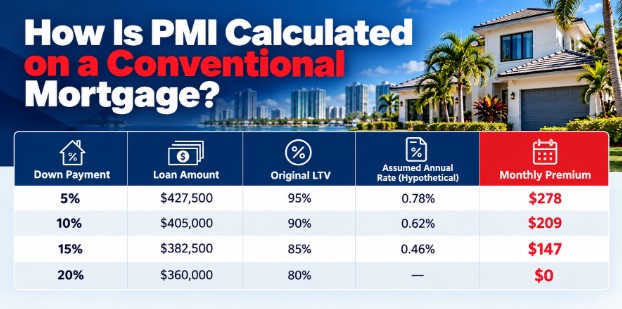
Most monthly private mortgage insurance plans calculate the premium as the original loan amount multiplied by an annual rate, divided by 12. Private mortgage insurance is a lender-protection policy that a conventional borrower funds when the down payment falls below 20% of the purchase price.
The industry does not use a uniform billing structure. A borrower’s own rate depends on the loan-to-value ratio at origination, credit tier, loan structure, and occupancy, and changes only through a refinance, which triggers a new lending appraisal and a fresh premium calculation.
A hypothetical $450,000 Miami-Dade purchase produces the following monthly premiums across four down-payment levels, using assumed rates for illustration only.
| Down Payment | Loan Amount | Original LTV | Assumed Annual Rate (Hypothetical) | Monthly Premium |
| 5% | $427,500 | 95% | 0.78% | $278 |
| 10% | $405,000 | 90% | 0.62% | $209 |
| 15% | $382,500 | 85% | 0.46% | $147 |
| 20% | $360,000 | 80% | None required | $0 |
The arithmetic explains why homeowners pursue cancellation as early as the rules allow. Actual pricing is risk-based and quoted per loan scenario by the insurer.
If you’re ready to get started, call us now!
The premium is calculated on the loan amount, while the appraised value decides the rate applied to it. Both figures matter at different stages, which is why mortgage sites give conflicting answers.
At origination, a lender uses the lower of the purchase price or the appraised value to establish the loan-to-value ratio. An appraisal above the contract price does not lower the premium on a purchase, because the purchase price controls.
An appraisal below it raises the ratio and pushes the borrower into a more expensive band, a scenario a Miami-Dade buyer can sometimes address through a reconsideration of value request.
After closing, the relationship reverses. The premium stays fixed against its original basis, and current value becomes the variable that can end the obligation early.
The analysis of loan amount versus appraised value examines the mechanics of that shift.
A servicer must terminate PMI automatically when the loan balance reaches 78% of the property’s original value on the scheduled amortization, with no request and no valuation required.
The Homeowners Protection Act of 1998 also gives a borrower the right to request cancellation in writing at 80%, and requires final termination at the midpoint of the amortization schedule for a borrower current on payments.
All three thresholds run against original value — the lesser of the purchase price or the original appraised value — not against what the property is worth in 2026. The Consumer Financial Protection Bureau examination procedures set out how servicers must apply each threshold.
Two conditions sit alongside the equity math. A servicer generally requires a clean recent payment history, and the statute permits the holder to require certification that the borrower’s equity is not encumbered by a subordinate lien.
Whether a particular second mortgage, home equity line, or recorded lien blocks a request depends on the servicer’s own treatment of it.
Yes, through investor servicing rules rather than federal law. The Homeowners Protection Act addresses original value only, so cancellation based on current appreciated value exists because Fannie Mae and Freddie Mac extend that option under their own servicing requirements.
Fannie Mae Servicing Guide B-8.1-04 sets the current-value criteria for qualifying principal residences and second homes: appreciation-based termination is unavailable during the loan’s first two years, then permitted at 75% loan-to-value between years two and five, and at 80% after five years.
Borrower-funded improvements change that sequence. Where the request rests on improvements made since origination, the two-year seasoning minimum can be waived at an 80% criterion, and the servicer must pass the borrower’s improvement details to Fannie Mae.
Documentation of those improvements matters, which is why homeowners benefit from knowing what to prepare before any inspection.
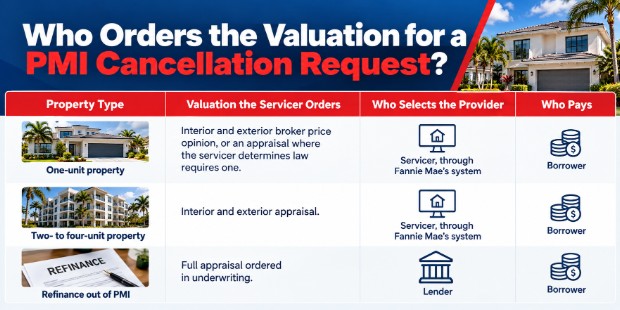
The servicer orders it, not the homeowner. This is the single most misunderstood step in the process, and getting it wrong costs a Miami-Dade borrower the price of a report nobody will use.
Fannie Mae Servicing Guide F-1-02 directs the servicer to obtain the valuation through Fannie Mae’s servicing solutions system after receiving the borrower’s request and the applicable fee. The valuation format depends on the property.
| Property Type | Valuation the Servicer Orders | Who Selects the Provider | Who Pays |
| One-unit property | Interior and exterior broker price opinion, or an appraisal where the servicer determines law requires one | Servicer, through Fannie Mae’s system | Borrower |
| Two- to four-unit property | Interior and exterior appraisal | Servicer, through Fannie Mae’s system | Borrower |
| Refinance out of PMI | Full appraisal ordered in underwriting | Lender | Borrower |
Freddie Mac and portfolio lenders maintain their own procedures, so the first step for any homeowner is to identify the loan’s investor and call the servicer’s mortgage insurance cancellation department to confirm what that investor requires.
An automated estimate carries no weight in any of these paths, a limitation covered in the comparison of online property estimates against inspected valuations.
Two- to four-unit Miami-Dade properties require a full appraisal, not a broker price opinion. Home Value Inc. produces USPAP-compliant reports — discuss the assignment.
FHA mortgage insurance premiums follow HUD rules rather than the Homeowners Protection Act, and the applicable rule depends on when the loan’s case number was assigned. Borrowers reading conventional PMI advice routinely assume it transfers, and it does not.
| Conventional PMI | FHA MIP (case numbers assigned on or after June 3, 2013) | |
| Governing framework | Homeowners Protection Act of 1998 plus investor servicing rules | HUD mortgagee letters issued under the National Housing Act |
| Automatic end | 78% LTV of original value on scheduled amortization | 11 years at original LTV of 90% or below; full mortgage term above 90% |
| Written request at 80% | Available to the borrower | Not available |
| Valuation showing appreciation | Considered under Fannie Mae and Freddie Mac rules | Does not terminate the premium |
| Route out via appreciation | Cancellation request to the servicer | Refinance into a conventional loan at 80% LTV or below |
FHA loans originated before that June 2013 boundary can fall under earlier cancellation provisions, so the case-number date determines which regime applies. Eligibility rules for each are set out in the breakdown of FHA mortgage insurance removal.
An independent appraisal is worth ordering in three situations, none of which involve substituting for a valuation the servicer controls. Home Value Inc., a residential appraisal firm in Miami Springs, Florida, serving Miami-Dade County, handles all three.
Fees vary by property type, size, location, and delivery timeline, with condominiums and waterfront properties costing more than a single-family base fee because comparable analysis takes longer.
Turnaround for a standard Miami-Dade residential property runs five to seven business days from order to delivery, and factors affecting that window are covered in the analysis of appraisal turnaround times.
A homeowner denied cancellation can require the servicer to state its grounds in writing, including the valuation result, and escalate through the CFPB complaint process.
How is PMI calculated on a conventional mortgage?
Most monthly PMI plans multiply the original loan amount by an annual premium rate, then divide by 12. Other plans apply the rate to the amortizing balance, and some reset after a set period, so the billing structure varies by insurer.
Which figure sets the PMI premium?
PMI is based on the loan amount, not the appraised value. Lenders set the premium against the original loan balance, while the appraised value determines the loan-to-value ratio that fixes the premium rate and later governs cancellation eligibility for conventional borrowers.
Does a rise in home value end PMI early?
Yes. Fannie Mae permits termination based on current value under Servicing Guide B-8.1-04, separate from the Homeowners Protection Act. The servicer orders the valuation through Fannie Mae’s servicing system once the borrower requests termination and pays the applicable fee for that loan.
How much equity is needed to cancel PMI in Miami-Dade County?
Conventional borrowers need 80% loan-to-value or below to request cancellation in writing against the original value. Automatic termination follows at 78%. Fannie Mae’s current-value criteria are 75% between loan years two and five, and 80% after five years for qualifying properties.
Does PMI ever end without reaching 78%?
Yes. The Homeowners Protection Act requires final termination at the midpoint of the loan’s amortization schedule for a borrower current on payments, even when the balance has not reached 78% of the original value. This provision applies to conventional mortgages.
Do FHA loans follow the same PMI rules?
FHA loans carry mortgage insurance premiums under HUD rules rather than the Homeowners Protection Act. For case numbers assigned on or after June 3, 2013, appreciation alone does not end MIP. Older FHA loans may follow earlier cancellation provisions set by HUD.
Does a PMI removal calculator replace a valuation?
No. A PMI removal calculator estimates the monthly premium and the projected 78% termination date based on the scheduled amortization. The servicer decides a current-value request instead through the BPO or an appraisal it orders through Fannie Mae’s servicing system for the borrower’s loan.
Will a mortgage servicer accept a borrower-ordered appraisal?
Generally not for a Fannie Mae current-value request. Servicing Guide F-1-02 directs the servicer to order an interior and exterior BPO on one-unit properties, or an appraisal on two- to four-unit properties, at the borrower’s expense.
How long does an independent Miami-Dade appraisal take?
Home Value Inc. schedules the inspection within one to two business days of order confirmation. Total turnaround for a standard Miami-Dade residential property runs five to seven business days from order to delivery.
Does the Miami-Dade assessed value affect PMI eligibility?
No. The Miami-Dade County Property Appraiser sets assessed value for property tax purposes only. A servicer evaluates PMI cancellation against the market valuation it obtains, so a low tax assessment carries no weight in that decision for conventional borrowers.
What happens when the valuation comes in too low for PMI cancellation?
The loan has not yet met the loan-to-value criterion its investor applies. Homeowners can continue scheduled payments, apply additional principal, document value-adding improvements, or dispute a servicer-ordered valuation that omitted a relevant comparable sale in the same market area.
A refinance out of PMI needs its own valuation. Home Value Inc. appraises Miami-Dade property for that decision — start with a quote.
About the Author
South Florida Residential Appraiser · Expert Witness · Residential Valuation Specialist
Jhovan Rojas is a South Florida residential real estate appraiser with more than 20 years of experience valuing residential properties throughout Miami-Dade, Broward, and Palm Beach Counties. His appraisal experience spans multiple real estate market cycles, including the foreclosure-driven downturn of the late 2000s, the subsequent recovery period, and the rapid appreciation that followed the COVID-19 housing boom.
Throughout his career, Jhovan has appraised thousands of residential properties, including single-family homes, condominiums, multi-family residences, luxury estates, waterfront properties with boating access, and complex high-value residential assets. His expertise includes residential valuation, appraisal review, market analysis, lender compliance review, and expert witness services for litigation involving real estate valuation disputes.
In addition to performing residential appraisals, Jhovan has conducted appraisal reviews for lending institutions, supervised and mentored trainee appraisers, and provided expert testimony in divorce and property-related legal matters. He is also a frequent speaker for Realtor and broker education programs, where he shares insights on valuation methodology, appraisal standards, market trends, and factors influencing residential property values throughout South Florida.
Drawing on decades of hands-on appraisal experience, Jhovan helps homeowners, attorneys, lenders, real estate professionals, and property investors make informed decisions based on credible, well-supported valuation analysis.
Home Value Inc. performs residential and commercial appraisals for its clients in greater Miami-Dade County and the following cities in South Florida. We provide services to the following cities -