Reviewed by Jhovan F. Rojas, Florida Certified Residential Appraiser (License RD6109), who has held his Florida appraisal license since 2006 and supervises appraiser trainees.
The Miami-Dade Value Adjustment Board is an independent panel, administered by the Clerk of the Court and Comptroller, that hears owner challenges to the Property Appraiser’s values.
Owners who plan to use a certified tax protest appraisal need it finished before the board’s short deadlines.
A petition is due on the 25th day after the August TRIM notice is mailed. Evidence must then reach two different places before the telephone hearing. Home Value Inc., a real estate appraisal firm in Miami Springs, Florida, prepares these reports.
Owners facing a tight 25-day window can start early with a free assessment review from Home Value Inc., before any fee.
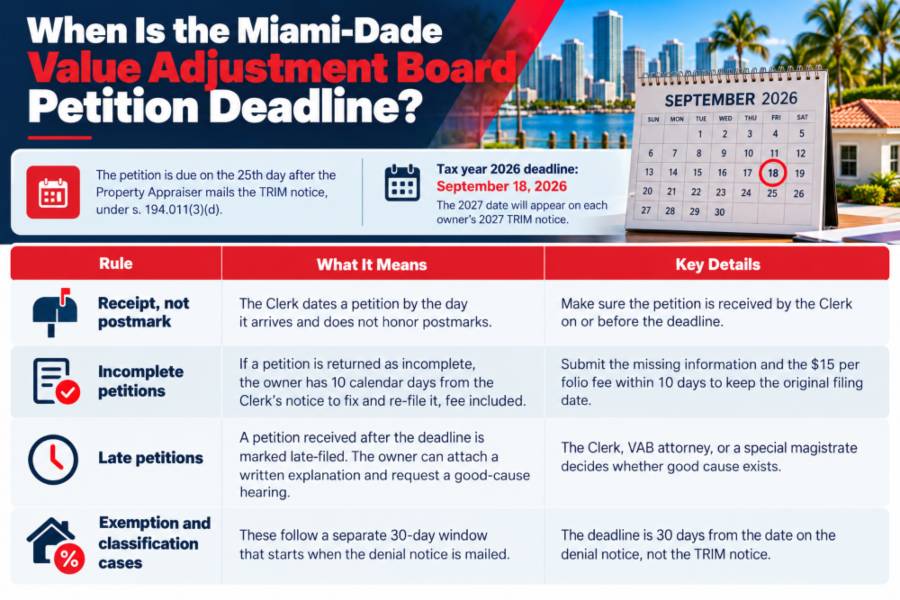
A value petition is due on the 25th day after the Property Appraiser mails the TRIM notice, under s. 194.011(3)(d). For tax year 2026, that day was September 18, 2026, and the 2027 date will appear on each owner’s 2027 TRIM notice.
The Clerk’s local VAB procedures add four rules:
Owners unsure whether to petition at all can weigh the informal review and circuit court routes that sit alongside a property tax appeal at the VAB.
Owners file the Department of Revenue’s DR-486 petition online, by mail or in person, and pay $15 per folio when they file. Condominium associations, cooperatives, and owners of contiguous undeveloped parcels filing a joint petition pay no more than $5 per parcel.
| Filing Route | How It Works | What the Owner Keeps |
| Online | VAB filing system linked from the Clerk’s site | AXIA receipt with a transaction number and password |
| DR-486 sent to the VAB main office, check payable to the Clerk of the Value Adjustment Board | The Clerk’s acknowledgment; the petition counts on the day it arrives | |
| In person | Stephen P. Clark Center, 111 NW First Street, Suite 1720 | The Clerk’s acknowledgment |
The sworn petition lists the parcel number and the time the owner needs to present. The owner signs it or attaches written authorization or a power of attorney.
A representative the owner retains can instead file by certifying that authority under penalty of perjury.
Under s. 194.011(3), this applies to the representatives listed in s. 194.034(1)(a): a Florida Bar attorney, a licensed real estate appraiser or broker, a CPA, or the owner’s employee.
The Clerk’s VAB page lists the filing links. Owners should save the AXIA receipt because its transaction number and password unlock the evidence upload later.
Before an owner files, Jhovan F. Rojas reviews the TRIM notice and closed sales. If the gap looks too small to justify an appraisal, he tells the owner before collecting any fee.
The calendar runs from January 1 into the following spring, with tax bills landing mid-season. The table labels each date as a statute, a Clerk procedure, or a typical pattern.
| Date | Event | Basis |
| January 1 | Valuation date for the tax year | Statute |
| August, usually the last week | TRIM notices mailed | Typical pattern (Clerk) |
| 25th day after mailing | Value petition deadline (September 18 in 2026) | Statute: s. 194.011(3)(d) |
| 30 to 60 days after mailing | Board first convenes | Statute: s. 194.032(1)(a) |
| 25 calendar days before each hearing | Hearing notice reaches the owner | Statute: s. 194.032(2)(a) |
| 15 days before the hearing | Evidence exchange with the Property Appraiser | Statute: s. 194.011(4) |
| 9:00 a.m., two non-holiday workdays before the hearing | AXIA upload deadline | Clerk procedure, memo effective August 31, 2026 |
| November 1 | Tax bills due, with a 4% discount through November | Statute: ss. 197.333, 197.162 |
| April 1 | Unpaid taxes become delinquent | Statute: s. 197.333 |
| April 20 | Board denies value petitions lacking the 75% payment | Statute: s. 194.014(1)(c) |
| 20 days after the board’s last session day | Written decisions issued | Statute: s. 194.034(2) |
Under s. 194.032, the board stays in session until every petition is heard, so many owners get their November bill before a decision. Paying in November keeps the 4% discount and meets the 75% rule. Under s. 197.333, unpaid taxes become delinquent on April 1.
A 25-day window leaves little slack; Home Value Inc prioritizes protest orders placed within 10 days of the TRIM mailing, so book early.
If you’re ready to get started, call us now!
The owner and the Property Appraiser may each reschedule a hearing once, and only for good cause. Under s. 194.032(2)(a), good cause means events outside the party’s control that would leave it without proper representation. The Clerk’s local procedures spell out what qualifies:
Under the Clerk’s telephonic hearing procedures, effective August 31, 2026, every Miami-Dade VAB hearing runs by phone unless the board says otherwise. Only the special magistrate and a VAB clerk sit in the hearing room.
A typical hearing runs like this:
The magistrate then sends a recommendation to the board, which can act on it without another hearing under s. 194.035. The memo also lets a petitioner request an in-person hearing.
This is a local procedure, not a statutory right, and the board grants it only to petitioners who have complied with Florida law, the exchange and upload rules, and the board’s conduct standards.
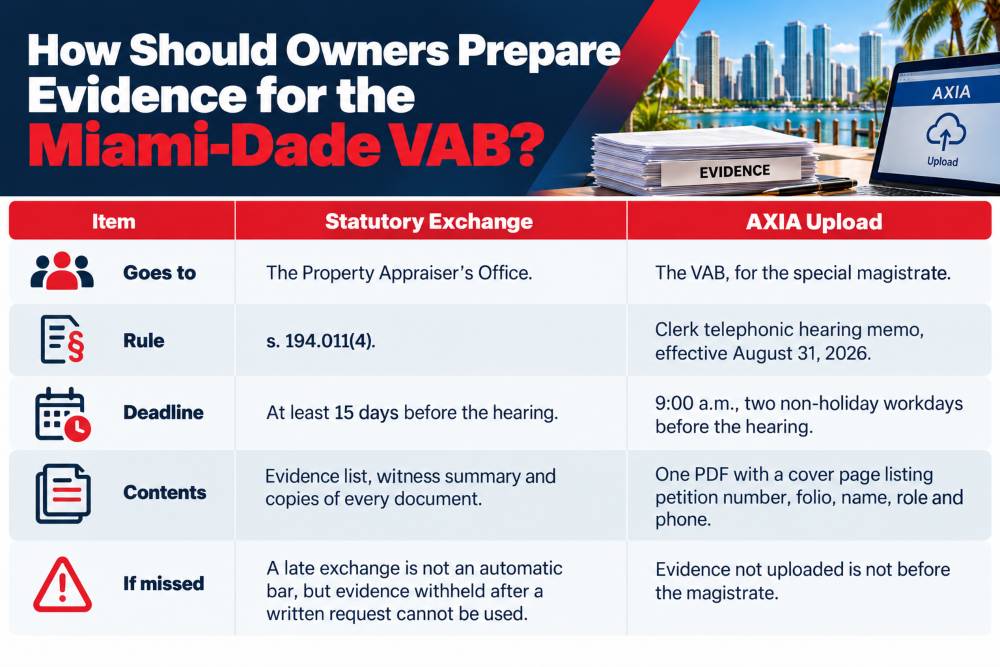
Evidence travels on two separate tracks, and the Clerk requires both: the statutory exchange with the Property Appraiser and the AXIA upload for the special magistrate.
| Statutory Exchange | AXIA Upload | |
| Goes to | The Property Appraiser’s Office | The VAB, for the special magistrate |
| Rule | s. 194.011(4) | Clerk telephonic hearing memo, effective August 31, 2026 |
| Deadline | At least 15 days before the hearing | 9:00 a.m., two non-holiday workdays before the hearing |
| Contents | Evidence list, witness summary and copies of every document | One PDF with a cover page listing petition number, folio, name, role and phone |
| If missed | A late exchange is not an automatic bar, but evidence withheld after a written request cannot be used | Evidence not uploaded is not before the magistrate |
The exchange packet includes a protest appraisal report and anything the office requested in writing. The Property Appraiser owes its own evidence and property record card on the same schedule. The Department of Revenue’s taxpayer guide to VAB petitions explains how to ask the Clerk for a new date if that evidence doesn’t arrive.
Uploading is not the same as admission. Each side can object to evidence during the hearing, and the special magistrate rules on what comes in. The memo also lets the VAB attorney exclude an entire packet as an evidentiary tactic.
The August 31, 2026 memo replaces earlier telephonic memos, so older instructions that list a different upload time no longer apply. Under the current memo, a Friday hearing needs the packet by Wednesday at 9:00 a.m.
| Property Type | Evidence the Clerk’s 2026 Information Sheet Lists |
| Any property with condition problems | Dated photos, plus repair estimates or bills dated close to or after January 1 |
| Homes and other non-income property | Appraisals, area sales, surveys and closing statements for sales in the prior three years |
| Income property | Three years of federal returns and financial statements, operating statements, a rent roll, current leases and comparable sales |
The Clerk’s 2026 information sheet places the burden on the owner. The owner must show, more likely than not, that the Property Appraiser’s January 1 value is higher than the property’s just value, meaning its market value on that date.
In appraisal practice, adjusted comparables usually meet that burden more directly than a raw sales printout, though the weight of any evidence depends on its quality. That matters most in cities such as Coral Gables, where historic designation and sharp neighborhood price tiers complicate comparable selection.
Income property such as offices, warehouses, and apartment buildings is usually valued with the rent roll and operating history the information sheet requests.
A tax appeal appraisal values the property as of January 1 of the tax year, while a listing price or online estimate reflects the market on the day it runs. That date decides which sales count and how condition is described.
Home Value Inc’s service is the valuation report; legal questions about filing rights belong with a property tax attorney.
When is the Miami-Dade VAB deadline for 2027?
The 2027 deadline falls on the 25th day after the Property Appraiser mails 2027 TRIM notices, which usually go out in the last week of August. The exact date prints on each TRIM notice. For tax year 2026, the deadline was September 18, 2026.
Can I file a Miami-Dade VAB petition online?
Yes. The Clerk’s VAB filing system accepts petitions online and issues an AXIA receipt with a transaction number and password. Owners pay the $15 fee per folio at filing, and Florida law treats a petition filed without the fee as invalid.
Do I need to upload evidence to AXIA if I already sent it to the Property Appraiser?
Yes. The Property Appraiser exchange and the AXIA upload are separate requirements, and the Clerk expects both. Uploading does not guarantee admission, since the special magistrate rules on objections at the hearing, and any appraisal timeline must leave room for both deadlines.
Can I attend my Miami-Dade VAB hearing in person?
Possibly. Hearings are held by telephone, and the Clerk’s local memo, not a statute, allows a petitioner to request an in-person hearing. The board grants it only to owners who have complied with Florida law, the exchange and upload rules, and its conduct standards.
How long does a Miami-Dade VAB decision take?
The special magistrate’s recommendation goes to the board, which issues written decisions within 20 calendar days after its last session day under s. 194.034(2). The board stays in session until it hears every petition, so timing depends on when a case lands on the docket.
Can I get a recording of my VAB hearing?
Yes. The hearing room’s audio and video system records every hearing, including telephone audio. The Clerk charges $10 per agenda number for a copy, up to $35 per hearing date, per the Clerk’s VAB fee list. Requests go to the Clerk’s VAB office.
Can I use a Zestimate as evidence at my VAB hearing?
An owner can submit one, but an automated estimate usually carries less weight than adjusted evidence because nobody inspected the property or adjusted the comparables. The special magistrate is a certified appraiser, so online estimates work best alongside adjusted sales and photos.
Who sits on the Miami-Dade Value Adjustment Board?
The board has five members under s. 194.015: two county commissioners, one school board member, and two citizen members. The county commission appoints a homestead owner, and the school board appoints a business owner who occupies commercial space in the school district.
The Miami-Dade VAB process rewards owners who plan backward from the TRIM notice and decide early whether an appraisal is worth its fee. Owners with a clear gap between the January 1 value and adjusted sales should line up evidence before August, keep both evidence tracks on schedule, and pay at least 75% of the tax by April 1. Owners with a small gap or a large homestead cap difference often benefit from a free record review.
Missing one VAB date can sink a strong case; plan the appraisal with Home Value Inc., starting with a review of the TRIM notice.
About the Author
South Florida Residential Appraiser · Expert Witness · Residential Valuation Specialist
Jhovan Rojas is a South Florida residential real estate appraiser with more than 20 years of experience valuing residential properties throughout Miami-Dade, Broward, and Palm Beach Counties. His appraisal experience spans multiple real estate market cycles, including the foreclosure-driven downturn of the late 2000s, the subsequent recovery period, and the rapid appreciation that followed the COVID-19 housing boom.
Throughout his career, Jhovan has appraised thousands of residential properties, including single-family homes, condominiums, multi-family residences, luxury estates, waterfront properties with boating access, and complex high-value residential assets. His expertise includes residential valuation, appraisal review, market analysis, lender compliance review, and expert witness services for litigation involving real estate valuation disputes.
In addition to performing residential appraisals, Jhovan has conducted appraisal reviews for lending institutions, supervised and mentored trainee appraisers, and provided expert testimony in divorce and property-related legal matters. He is also a frequent speaker for Realtor and broker education programs, where he shares insights on valuation methodology, appraisal standards, market trends, and factors influencing residential property values throughout South Florida.
Drawing on decades of hands-on appraisal experience, Jhovan helps homeowners, attorneys, lenders, real estate professionals, and property investors make informed decisions based on credible, well-supported valuation analysis.
Home Value Inc. performs residential and commercial appraisals for its clients in greater Miami-Dade County and the following cities in South Florida. We provide services to the following cities -